Question & Thought for 3 September 2015!!!

Good Thursday Morning and Happy Birthday!!!
1. Question – What is an agnostic and how would you go about questioning his questions about God?
2. Thought – Agnostic -a person that holds the view that the ultimate reality (as God) is unknown and probably unknowable; one who is not committed to believing either the existence or the non-existence of God or a god; a person unwilling to commit an opinion about something.
“Well, Don, there are two kinds of agnostics,” I explained. “There’s the ordinary agnostic who says he doesn’t know anything for sure, and then there’s the ornery agnostic who says he can’t know anything for sure.”
Don was sure about his. He said, “I’m the ornery kind. You can’t know anything for sure.”
Recognizing the self-defeating nature of his claim, I unleashed the Road Runner tactic by asking him, “Don, if you say you can’t know anything for sure, then how do you know that for sure?”
Looking puzzled, he said, “What do you mean?”
Explaining it another way, I said, “How do you know for sure that you can’t know anything for sure?”
I could see the lightbulb coming on but decided to add one more point: “Besides, Don, you can’t be a skeptic about everything because that would mean you’d have to doubt skepticism; but the more you doubt skepticism the more sure you become.”
He relented. “Okay, I guess I really can know something for sure. I must be an ordinary agnostic.”
Now we were really getting somewhere. With just a few questions, Don had moved from atheism through ornery agnosticism to ordinary agnosticism.
I continued, “Since you admit now that you can know, why don’t you know that God exists?”
Shrugging his shoulders he said, “Because nobody has shown me any evidence, I guess.”
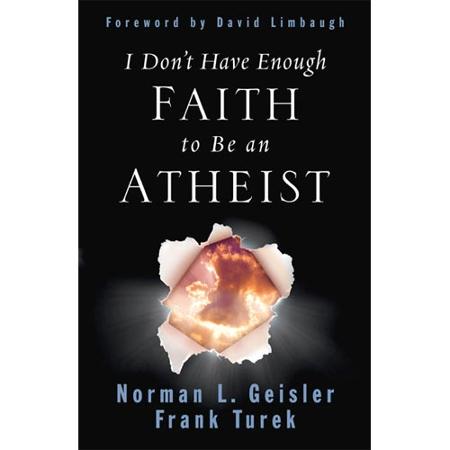
This is the best person to talk to: someone who is willing to take an honest look at the evidence. Being willing is essential. Evidence cannot convince the unwilling. (I Don’t Have Enough Faith To Be An Atheist by Norman L. Geisler and Frank Turek)

“All energy comes from God.” (DMBR)

rem – know the why or lose the way! 
Question & Thought & ANDs.

Question & Thought for July 17th, 2015!!!

Good Friday Morning!
1. Question – What are the 5 most consequential questions in life?
2. Thought – Indeed, the five most consequential questions in life are these:
  1. Origin: Where did we come from?
  2. Identity: Who are we?
  3. Meaning: Why are we here?
  4. Morality: How should we live?
  5. Destiny: Where are we going? (I Don’t Have Enough Faith To Be an Atheist by Norman L. Geisler and Frank Turek)
“If we admit God, must we admit Miracle? Indeed, indeed, you have no security against it. That is the bargain.” (C.S. Lewis)
Be careful on the roads. Drink lots of water. Read a bit and discern a bit. And – perhaps do a random act of kindness for someone this weekend and do let anyone know.

rem – know the why or lose the way! 
Question & Thought & ANDs.

Question & Thought for May 6th, 2015!!!

Hello truthful friends!!!
1. Question – How can we know what is true?
2. Thought – We have said that truth must match the real world – the way things really are. It must “tell it like it is.” So how can we know? Two tests can help us discover whether or not something is true.
Test # 1: Examining All the Facts to See What Matches Reality.
Truth must be backed up by facts, supported by outside evidence rather than personal opinions. Here are 3 examples of what some people believe despite the facts: The Holocaust never happened; the U.S. never landed anyone on the moon; a group of Jews attacked the World Trade Center.
How would you show these statements are untrue?
You could use WWII newsreels, for example, to substantiate the Holocaust. You could appeal to the eyewitness testimony of those who worked on the lunar landing and those who actually went. You could point to all the evidence left behind by those who hijacked the planes on 9/11. You could prove your case by collecting the facts.
Test #2: Learning to Think Correctly (Logically).
God has also instituted certain unbreakable laws of right, or correct thinking, which we call the laws of logic. One is known as the law of noncontradiction.
It says, “Two contradictory, or opposite, truth claims cannot be true at the same time and in the same sense.” The contradiction to “God exists” is “God does not exist,” and the law of noncontradiction says that these two truth claims can’t both be true-God can’t both exist and not exist.
Why is this so important, and why should you spend your time on it? Because while it’s common today to maintain that all belief systems are equally true, or that no belief system has any “truth advantage” over any other, the fact that religions contradict each other at many major points.
For example, let’s look at just three key Christian beliefs about Jesus: (1) Jesus is God; (2) Jesus has always been God; he did not at some point in time become God; (3) only Jesus is God; people are not God.
Here’s the issue: Every other system of beliefs contradicts these claims. Hindus say Jesus is one of many men who’ve become God. Mormons believe that Jesus was a man before he became God, and that worthy Mormons can become gods one day also. Muslims esteem Jesus as one of Allah’s great prophets, but they do not believe he is God. Buddhists hold Jesus to be one of many remarkable teachers. Judaism does not believe Jesus is God. Each religion believes something contradictory about who Jesus is or who he claimed to be.
This is where the law of noncontradiction becomes crucial. It tells us that someone is right and someone is wrong about Jesus. All these ideas about him cannot be right, because they are contradictory. If Christianity is true – if what it says about Jesus is true – then all these other beliefs systems are wrong. (Reasons for Belief by Norman L. Geisler and Patty Tunnicliffe)


​”You must accept the truth from whatever source it comes.” [Moses Maimonides]​
​Humm?​


rem – know the why behind the what! 
Question & Thought & ANDs.